How AI Is Revolutionizing Predictive Maintenance in Offshore Wind Energy

Offshore wind energy has matured rapidly over the past decade, but one persistent challenge continues to weigh on project economics: keeping turbines running reliably in some of the world's most hostile environments. Artificial intelligence is changing that equation, and the shift is happening faster than most operators anticipated.

The Maintenance Challenge Unique to Offshore Wind

Offshore wind maintenance is fundamentally more expensive and logistically complex than its onshore counterpart — and that gap is wide. Accessing a turbine 30 to 80 kilometers from shore requires specialized crew transfer vessels or helicopters, both weather-dependent and costly. A single technician visit can run into tens of thousands of dollars before any repair work even begins.

Unplanned downtime is where offshore operators feel the most financial pain. When a gearbox fails unexpectedly mid-winter in the North Sea, the combination of vessel day rates, spare part lead times, and lost generation revenue can push total incident costs into the hundreds of thousands. Industry estimates suggest O&M costs account for 25–35% of the lifetime cost of an offshore wind project — a figure that dwarfs onshore equivalents.

The marine environment compounds every problem. Salt air accelerates corrosion, wave-induced loading stresses structural components, and the sheer distance from port limits how frequently technicians can realistically inspect assets. Traditional scheduled maintenance — sending crews out on fixed intervals regardless of actual component condition — was never a perfect fit for offshore. It wastes resources when components are healthy and still misses failures that develop between visits.

What Is AI-Driven Predictive Maintenance?

Predictive maintenance (PdM) is a condition-based strategy that uses real-time data and analytical models to forecast when a component is likely to fail, enabling intervention before breakdown occurs. AI-driven PdM goes further by applying machine learning algorithms to detect subtle patterns in sensor data that human analysts would likely miss.

The distinction from traditional approaches matters. Reactive maintenance waits for failure — expensive offshore. Scheduled maintenance operates on fixed time intervals — often wasteful. Predictive maintenance acts on actual equipment condition, targeting the right component at the right time. When machine learning is layered on top, the system continuously improves its predictions as it ingests more operational data from the fleet.

For offshore wind operators, this shift from calendar-based to condition-based decision-making translates directly into fewer emergency callouts, better vessel utilization, and longer component lifespans. The AI doesn't replace the maintenance engineer — it gives that engineer a much clearer picture of what needs attention and when.

Key Technologies Enabling AI Predictive Maintenance

The technology stack behind offshore predictive maintenance works as an interconnected system, not a single product. Each layer feeds the next, and the value of AI depends entirely on the quality of data flowing through the chain.

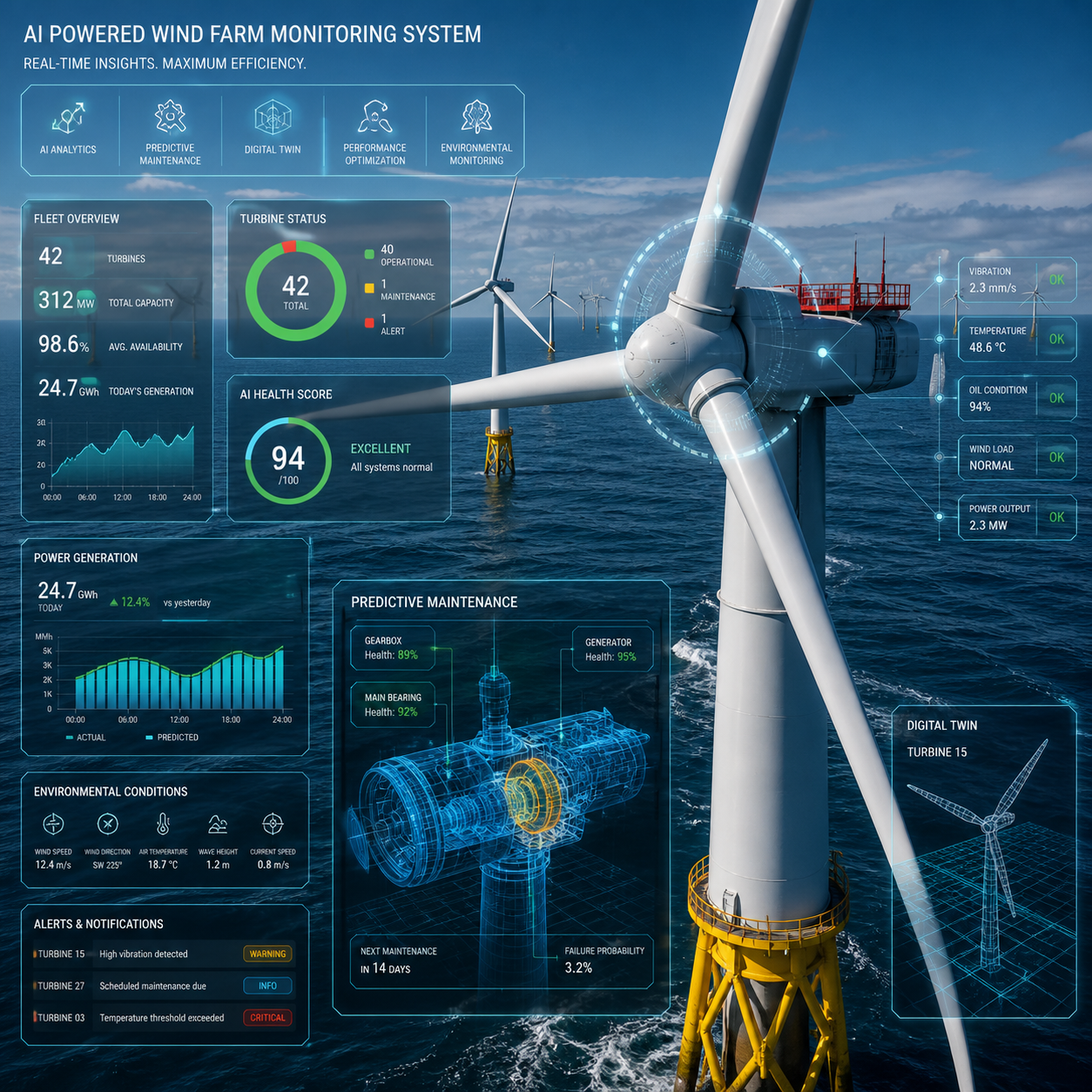
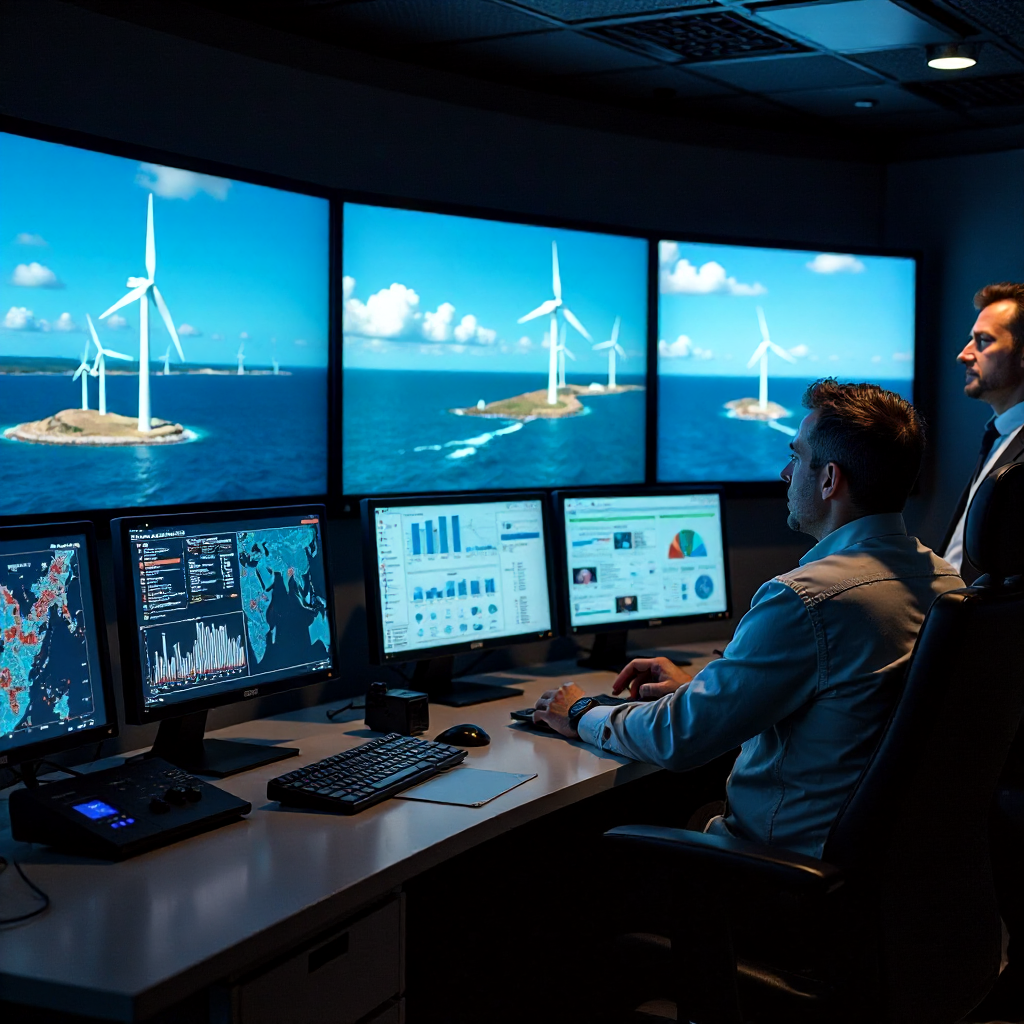
Condition monitoring systems (CMS) sit at the foundation. These sensor arrays — accelerometers, temperature probes, oil quality sensors, strain gauges — continuously measure the physical state of critical components including gearboxes, main bearings, generators, and blades. Vibration analysis is particularly valuable: changes in vibration frequency signatures can indicate bearing wear, gear tooth damage, or rotor imbalance weeks before failure becomes visible.

That raw sensor data flows into SCADA systems, which have been standard in wind farms for years. SCADA platforms aggregate operational data — power output, wind speed, pitch angles, temperature readings — and provide the historical dataset that machine learning models train on. Most offshore farms already have SCADA infrastructure in place, which means the data pipeline exists; the challenge is making better use of what's already being collected.

Machine learning algorithms then process this combined data stream, building statistical models of normal turbine behavior and flagging deviations that suggest developing faults. Anomaly detection models, regression models predicting remaining useful life, and classification algorithms identifying specific fault types all play roles depending on the application.

Digital Twins and Their Role in Turbine Health Monitoring

A digital twin is a virtual model of a physical asset that mirrors its real-world counterpart in real time, enabling simulation and prediction that physical inspection alone cannot provide. In offshore wind, digital twins of individual turbines represent one of the most promising extensions of AI predictive maintenance.

By combining physics-based models of drivetrain behavior with live sensor feeds, a digital twin can simulate how a component will respond to specific loading conditions — essentially running thousands of scenarios to predict where stress will concentrate and when fatigue limits will be approached. This moves beyond pattern recognition into genuine prognostics: not just "something looks wrong" but "this gearbox bearing has approximately 600 operating hours remaining under current load profiles."

For offshore operators managing large fleets, digital twins also enable fleet-level comparisons. If turbine 14 in a 60-turbine array is degrading faster than statistically similar machines under comparable wind conditions, that deviation becomes visible early. The maintenance team can investigate before the discrepancy becomes a failure.

The technology is not yet universally deployed — building accurate digital twins requires substantial upfront modeling effort and high-quality historical data — but adoption is accelerating as turbine OEMs and independent software vendors develop more accessible platforms.

Operational and Financial Benefits for Offshore Operators

The core value proposition of AI-driven predictive maintenance is straightforward: fewer surprises, better-planned interventions, and lower total O&M costs. The specifics vary by fleet size and asset age, but the directional benefits are consistent across offshore wind projects.

Reducing unplanned downtime is the headline benefit. Emergency repairs offshore carry a cost multiplier compared to planned maintenance — vessel mobilization on short notice, premium pricing for urgent spare parts, and lost generation during extended outages. Catching a developing gearbox fault four to six weeks in advance allows operators to schedule the repair during a planned maintenance window, coordinate vessel access efficiently, and source components at standard lead times.

Extended component life is a secondary but significant benefit. Many failures are preceded by extended periods of abnormal but not yet critical operation. Identifying this degradation early allows operators to adjust operational parameters — reducing rotor speed or load during high-stress conditions — to slow the progression and defer replacement until a more convenient window.

From a portfolio perspective, better maintenance planning improves availability rates, which directly affects energy yield and revenue. A 1–2 percentage point improvement in turbine availability across a large offshore array can represent meaningful additional generation over a project's lifetime.

Implementation Challenges and Considerations

AI predictive maintenance is not a plug-and-play solution, and operators who approach it as such tend to be disappointed. Several practical challenges shape how quickly and effectively organizations can realize the technology's potential.

Data quality and completeness is the most common stumbling block. Machine learning models are only as good as the data they train on. Sensor gaps, inconsistent labeling of historical fault events, and SCADA data that was never collected with analytics in mind can all undermine model accuracy. Many offshore operators discover that their existing data infrastructure needs significant cleanup and augmentation before AI models can be reliably trained.

Integration complexity is another real barrier. Connecting CMS hardware, SCADA platforms, and AI analytics software across systems from multiple vendors — often across a fleet of turbines from different manufacturers — requires careful engineering and ongoing maintenance of data pipelines. The offshore environment itself adds communication latency and bandwidth constraints that onshore deployments don't face.

Upfront investment is substantial. High-quality CMS sensor arrays, software licensing, data infrastructure, and the specialist expertise to build and validate models represent significant capital before any maintenance savings materialize. Smaller offshore portfolios may struggle to justify this investment without shared infrastructure or third-party managed services.

Finally, workforce adaptation matters more than most technology vendors acknowledge. AI tools generate alerts and recommendations, but maintenance engineers need to understand the models well enough to trust — and appropriately question — their outputs. Organizations that invest in training alongside technology deployment consistently see better outcomes than those that treat AI as a black box.

The Future of AI in Offshore Wind Maintenance

The trajectory of AI in offshore wind maintenance points toward greater autonomy, broader data integration, and fleet-scale intelligence. Several developments are worth watching closely.

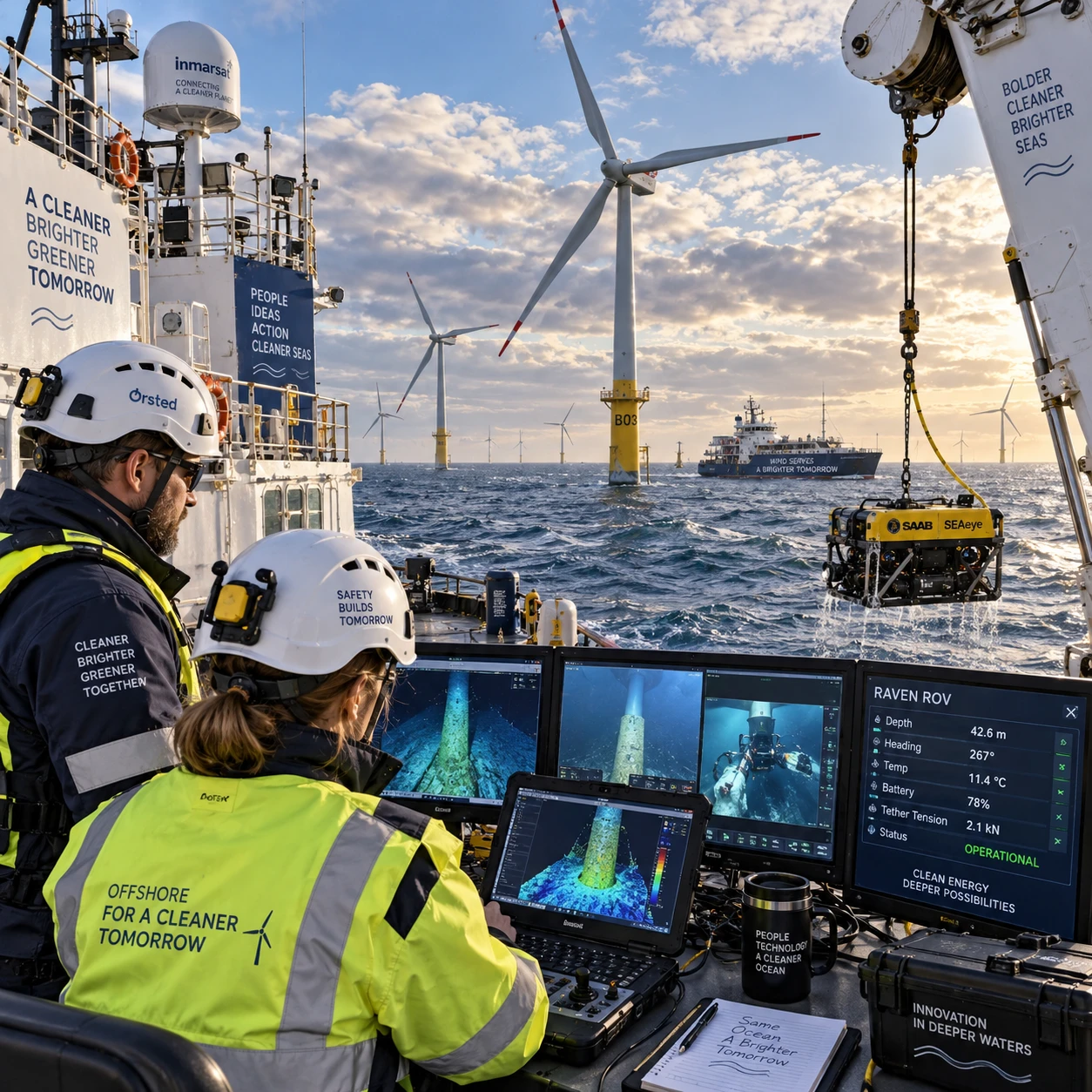
Autonomous inspection drones and underwater remotely operated vehicles (ROVs) are increasingly being paired with AI image recognition systems to automate visual inspections of turbine towers, blades, and subsea foundations. This reduces the need for human access in dangerous conditions and generates structured inspection data that feeds back into predictive models.

Fleet-level AI analytics — where models learn across hundreds of turbines simultaneously rather than treating each machine in isolation — is maturing. This approach dramatically increases the training dataset available to algorithms and enables cross-fleet benchmarking that single-asset models cannot provide. As the global offshore wind fleet grows, the collective data advantage compounds.

Regulatory frameworks are also evolving. Certification bodies and insurers are beginning to recognize AI-informed maintenance records as credible evidence of asset condition, which could eventually reduce mandatory inspection frequencies for well-monitored assets — a meaningful cost lever for offshore operators.

The honest assessment is that AI predictive maintenance in offshore wind is past proof-of-concept but not yet at full maturity. The tools are real, the benefits are documented, and adoption is accelerating — but significant work remains on data standardization, model interpretability, and workforce capability. Operators who start building their data foundations now will be better positioned to capture value as the technology continues to develop.

Frequently Asked Questions

What types of turbine failures can AI predictive maintenance detect early?

AI predictive maintenance is most effective at detecting mechanical degradation in high-value components: gearbox and drivetrain failures, main bearing wear, generator winding faults, and blade structural issues. Vibration analysis is particularly sensitive to early-stage gear tooth damage and bearing defects, often detecting anomalies 4–8 weeks before failure would occur under conventional monitoring.

How does predictive maintenance differ from condition-based monitoring?

Condition-based monitoring (CBM) alerts operators when a parameter crosses a predefined threshold — it tells you something is wrong now. Predictive maintenance uses machine learning to model degradation trajectories and forecast when a threshold will be crossed, giving operators lead time to plan interventions. PdM is proactive; CBM is reactive to condition changes.

What data inputs does an AI predictive maintenance system require?

Effective AI models typically draw on vibration sensor data, temperature readings from bearings and generators, oil quality measurements, SCADA operational data (power curves, pitch angles, rotor speed), and historical maintenance records including past fault events. Weather and marine environment data — wind speed, wave height, sea temperature — are increasingly incorporated to contextualize loading conditions.

Is AI predictive maintenance cost-effective for smaller offshore wind portfolios?

Smaller portfolios face a genuine challenge: the upfront investment in sensors, software, and expertise is relatively fixed regardless of fleet size, while the savings scale with the number of turbines. Third-party managed service providers and industry data-sharing consortia are emerging as ways to spread these costs. Below roughly 20–30 turbines, a rigorous cost-benefit analysis is essential before committing to a full implementation.

How does weather and marine environment data factor into AI maintenance models?

Offshore turbines operate under highly variable loading driven by wind and wave conditions. AI models that incorporate environmental data can distinguish between sensor anomalies caused by extreme weather events and those indicating genuine component degradation — reducing false alarms significantly. Marine environment data also helps models account for corrosion rates and fatigue loading specific to each turbine's location within the array.

{{HOMEPAGE_LINKS}}